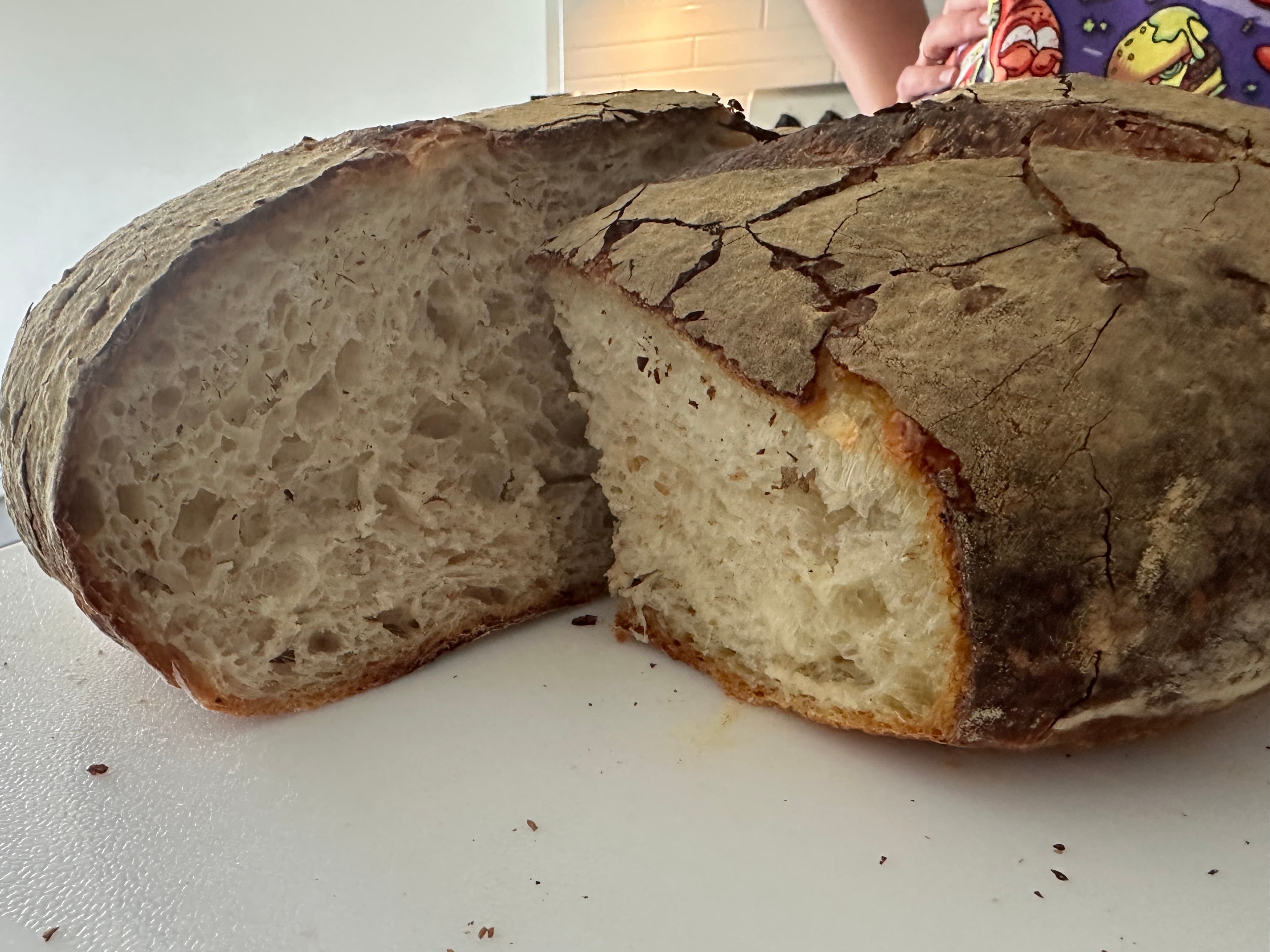
Sourdough Bread
Updated at
A straightforward, naturally leavened loaf with a crisp crust.
Ingredients
- 450 g bread flour (white, high-grade)
- 50 g whole wheat flour
- 350 ml water (plus 25 ml later, when adding salt)
- 100 g active sourdough starter
- 10 g fine salt
Tools
- Large mixing bowl
- Bowl cover (lid / plate / plastic wrap)
- Bench scraper (optional, helpful)
- Clean towel + bowl or proofing basket
- Parchment paper
- Razor blade or very sharp knife
- Oven
- 2 baking trays (one for bread, one for steam)
- Shot glass + plastic wrap (for the dough “test”)
Instructions
1. Prepare the starter (if it was in the fridge)
- Take the starter out of the fridge and let it come to room temperature in a dark place.
- Feed it: mix 90 g starter + 90 g water + 90 g flour.
- Wait 6–8 hours, until it reaches maximum rise (about 3x).
- Use the starter when it’s at peak.
2. Mix + autolyse (30 minutes)
- In a large bowl, mix 450 g white flour + 50 g whole wheat flour + 350 ml water + 100 g active starter.
- Cover and rest for 30 minutes.
3. Add salt (and extra water), then rest (30 minutes)
- Sprinkle 10 g salt over the dough.
- Add 25 ml of water.
- Mix by hand until the salt grains fully dissolve and the dough tightens up.
- Cover and rest for 30 minutes.
4. Set up the “dough test” indicator
- Pinch off a small piece of dough and put it into a shot glass.
- Cover the glass with plastic wrap and mark the starting level.
- When this test dough rises by about 20–30%, it’s a good signal the main dough is ready to shape.
5. Bulk fermentation + folds
- The dough should increase in volume a bit and feel more elastic over time.
- Do 3 rounds of folds:
Gently release the dough from the bowl bottom, then grab an edge, stretch it up, and fold it over the dough; repeat 5–6 times around the dough. Cover and rest 30 minutes. - Repeat this fold + 30-minute rest two more times.
- After the 3rd round, cover and leave the dough to ferment for 3–4 hours.
6. Shape (two-stage)
- Lightly flour the top of the dough.
- Lightly flour the table, then turn the dough out with the sticky side facing up.
- Do a gentle pre-shape: stretch and fold the dough onto itself to form a rough round or oval.
- Dust the sticky side with flour, flip seam-side down, and tighten the surface with gentle twisting/pulling motions (don’t tear the skin).
- Flip seam-side up again, cover with an upside-down bowl, and rest 30 minutes.
7. Final shape + proof
- Shape again (same idea: fold to build structure, then tighten the surface).
- Prepare a bowl/proofing basket: line it with a towel and dust the towel with flour.
- Transfer the dough seam-side up into the lined bowl.
- Cover with plastic wrap.
Optional overnight version:
- If baking tomorrow morning, refrigerate now.
- In the morning, take it out and let it warm up and rise for about 3–4 hours before baking.
Room-temperature version:
- Proof at room temperature for 3–4 hours.
8. Preheat the oven (last 1 hour of proof)
- Put two trays inside the oven: one on the lowest rack (for steam), one in the middle (for the bread).
- When there’s about 30 minutes left in proofing, preheat the oven to 230-240°C.
9. Bake with steam, then dry heat
- Turn the dough out onto parchment paper (so it’s ready to load).
- Score shallow cuts with a razor (about 1–2 mm deep), so the bread can open up during the first minutes.
- Prepare either 4–5 ice cubes or about 100 ml of boiling water.
- Work fast: open the oven, slide the bread (on parchment) onto the middle tray, add ice/boiling water onto the bottom tray, and close the door quickly.
- Bake 15 minutes with steam (water should be boiling).
- Bake 20 minutes without steam.
10. Cool
- Move the bread to a towel and let it cool for 1 hour before slicing.
- If you cut too early, the crumb can stay gummy and trap moisture inside.
Tips
- Keep steam moderate: too much steam can make the loaf spread instead of spring.
- If your dough feels very stiff after salt, don’t add more water than planned—wait 10 minutes and re-evaluate after the dough relaxes.
- If the crust is still pale after the full bake time, add 5–10 more minutes (without steam).